
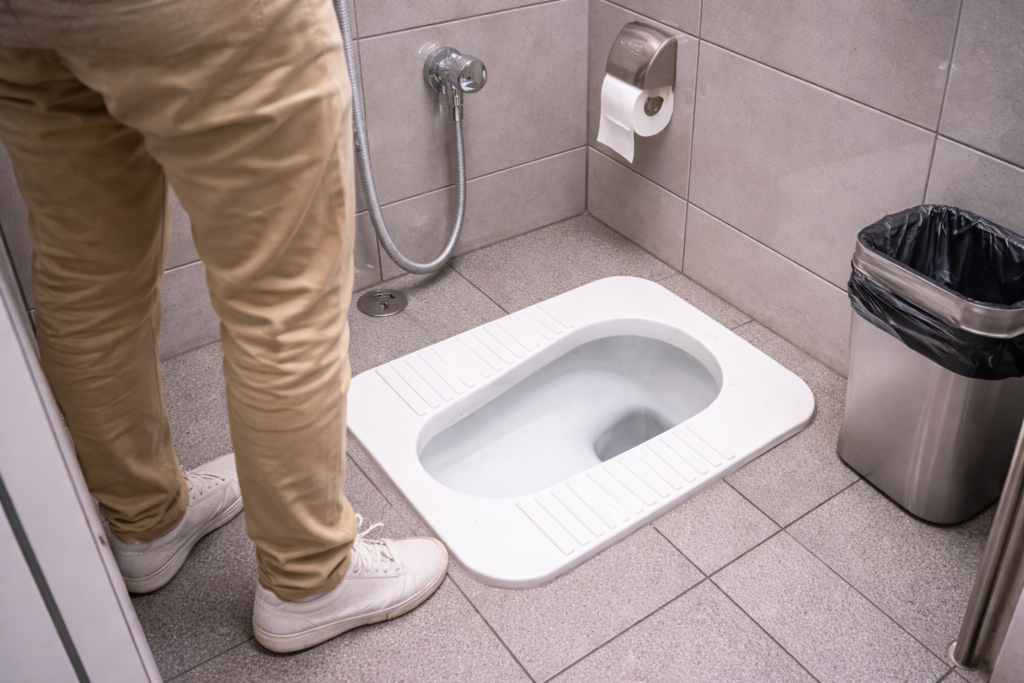
Why are asian toilets on the floor instead of raised on a pedestal like Western models? The short answer: a combination of history, infrastructure cost, hygiene logic, and deeply rooted cultural habits shaped how billions of people use restrooms every single day. Western visitors often assume the floor-level design is outdated, but that assumption misses the practical reasoning behind it.
This guide breaks down the real reasons these ground-level units remain widespread, how they compare to a sitting toilet, and what health research actually says about the crouching position versus sitting upright on a raised seat.
What Is a Squat Toilet?
A squat toilet is a fixture installed at floor level rather than elevated on a pedestal with a toilet seat. Users place their feet flat on raised footpads on either side of the basin and lower into a full crouch. No seat contact. No lid.
In its most basic form, the unit looks like nothing more than a hole in the ground with molded footrests. Modern versions connect to full flush systems and sewage lines identical to what you’d find behind any standard Western unit. The design goes by several names depending on the region: Japanese squat, asian squat toilet, or simply “squatty.”
Why Are These Fixtures Built at Ground Level?
Ground-level installation traces back to the earliest sanitation systems across parts of Asia. Before modern plumbing existed, waste removal meant pits in the ground. When ceramic basins and modern flushing arrived, the posture habit stayed. Builders upgraded the plumbing without changing the user’s body position.
Three factors kept the design locked in:
- Infrastructure continuity. Existing sewage pipe layouts in older buildings and rural areas were designed for ground-level drainage. Retrofitting for a raised pedestal means rerouting pipes, raising costs substantially.
- Cost. A basic ground-level unit costs less to manufacture, install, and maintain than a raised bowl with a hinged seat, tank, and wax ring seal.
- Cultural preference. Billions of people grew up crouching. Switching posture feels unnatural to someone who has used this method their entire life.
Are Asian Toilets on the Floor More Hygienic?
From a pathogen transmission standpoint, there’s a real argument here. With a floor-level unit, your skin never touches a shared surface. No shared toilet seat means no surface-to-skin contact in public restrooms where hundreds of people cycle through daily.
In high-traffic public places, a raised seat collects bacteria from every user. Floor-level units eliminate that contact point entirely. That’s one reason the World Health Organization’s sanitation guidelines don’t favor one design over another for hygiene outcomes. Both work if cleaned properly.
However, cleanliness depends more on maintenance frequency than on design. A poorly maintained unit in a bus station isn’t cleaner than a well-maintained sitting fixture in a hotel. Cleaning practice matters more than fixture type.
Why Public Toilets Still Use Floor-Level Designs
Durability drives this decision. A raised seat cracks under heavy use. Hinges break. Lids warp. A floor-level basin has zero moving parts. Nothing to snap, unscrew, or replace.
Cleaning crews can hose down the entire surface in seconds. No need to scrub around a seat hinge or under a rim. For airports, train stations, and bus terminals handling thousands of visitors per day, that maintenance simplicity adds up fast.
Many modern public toilets now offer both options side by side. One with a Western raised fixture, another with a floor-level squat unit. Travelers pick what they’re comfortable with. If you’re learning how to use a squat toilet for the first time, this dual setup gives you a fallback option.
Chinese Toilets and Restroom Culture in China
Chinese public spaces still favor floor-level units, especially outside Beijing and Shanghai. Restrooms in China’s smaller cities and rural villages rely almost exclusively on squat designs. The infrastructure was built for them, and the population grew up with them.
That said, modernization is moving fast. Urban malls, international airports, and new hotel construction increasingly install raised Western units with wash attachments. Some high-end Chinese restrooms now rival what you’d find in Tokyo or Singapore.
Many Chinese people still prefer the crouching posture by choice, even when a raised option is available. Habit is powerful. When you’ve used a floor-level unit every day since childhood, sitting on a cold raised seat feels strange.
A Brief History of Asian Squat Toilets
Crouching was the universal human posture for defecation for thousands of years. Every culture did it. The split happened during Western Europe’s industrialization, when raised pedestal designs became standard in England and then spread across the United States and the rest of the West.
Asian countries, the Middle East, and portions of Africa never made that switch. Modern flushing technology arrived, but the body position stayed the same. Japan offers the clearest example: the country adopted advanced flush systems and electronic bidet seats while simultaneously keeping traditional floor-level units in older buildings and some train station restrooms.
Korea followed a similar path. Older buildings retain ground-level units while new construction defaults to raised seats with integrated wash functions.
Health Benefits: Are Squat Toilets Better for Your Body?
Research on defecation postures suggests crouching straightens the rectum and relaxes the puborectalis muscle (part of the levator ani group), creating a more direct path for elimination. The sitting position on a raised seat leaves the rectal canal partially kinked, which can require more strain.
Reduced strain may lower the risk of hemorrhoid development, constipation, and in some cases, conditions like rectocele or rectal prolapse. A 2019 study published in the Journal of Clinical Gastroenterology found that participants using a raised footstool (simulating a crouch) reported faster, more complete bowel movements.
Does that mean floor-level fixtures are strictly better? Not necessarily. People with knee injuries, limited mobility, or joint conditions find crouching painful or impossible. The health benefit depends entirely on the individual. For healthy adults with full range of motion, the squatting position does offer a biomechanical advantage for bowel function.
How to Use a Floor-Level Toilet Properly
Position your feet on the textured footpads on either side of the basin. Face the hooded end (the end with the splash guard or raised lip). Lower yourself into a stable crouch with your weight on your heels, keeping your feet flat on the ground.
Stay balanced. Keep your center of gravity low. One tip most guides skip: empty your pockets first. Phones, wallets, and keys have a habit of sliding out during a deep crouch.
Toilet paper may not be provided in many public restrooms across the continent. Carry a small pack. Some facilities provide a water hose or bucket for washing instead. This is standard practice, not a sign of poor maintenance. For a complete walkthrough, see our guide to understanding these fixtures.
Toilets in Japan: A Unique Contrast
Japan stands apart. The country simultaneously produces the world’s most advanced electronic wash seats (the TOTO Washlet being the most recognized) and still maintains traditional floor-level units in older buildings. If you’re curious about Japanese wash and dry technology, we’ve covered Japanese bidet and dryer systems in detail.
New construction in Japan almost exclusively uses raised Western units with heated seats, automatic lids, and integrated wash/dry cycles. But walk into an older temple, a rural train station, or a small izakaya, and you’ll find a ceramic floor-level unit.
The coexistence isn’t contradictory. Japan values both tradition and innovation. Some Japanese units even include integrated sinks on the tank to save water and space.
Why the Full Transition to Raised Seats Hasn’t Happened
Money is the biggest barrier. Retrofitting millions of public restrooms across entire asian countries requires massive capital investment. Existing sewage systems in older buildings were engineered for floor-level drainage. Switching means new pipes, new subfloor work, and new fixtures.
Cultural comfort matters just as much. In many communities, crouching feels more natural and more sanitary than sitting on a surface strangers have used. Urination is also simpler with certain ground-level designs, particularly for women in public settings where seat contamination is a concern.
The trend is clearly moving toward raised units in new construction, especially in urban centers across Asia. But millions of existing units aren’t going anywhere soon. The replacement will take decades, and some countries may never fully switch.
Maintenance Economics Most Guides Overlook
Here’s what most articles miss: the total cost of ownership. A raised unit with a seat needs replacement hinges, wax seals, fill valves, and flush handles. A ground-level basin needs almost nothing beyond the flush mechanism itself.
For a city managing thousands of public facilities, that cost difference compounds. Fewer parts break. Fewer service calls. Faster cleaning cycles. One maintenance worker can service twice as many ground-level units per shift compared to raised units with seats and tanks.
That’s not a small consideration when you’re managing sanitation infrastructure for a city of 10 million people. Practicality beats aesthetics at that scale.
Frequently Asked Questions
Why are Chinese toilets on the ground?
Chinese public facilities use floor-level designs because the infrastructure was built around them, the cost is lower, and cultural preference for crouching remains strong, especially outside major metropolitan areas.
Are Japanese toilets on the floor?
Some are. Older buildings and rural stations still have floor-level units, but most new Japanese construction uses advanced Western raised seats with electronic wash and dryer functions.
Why do some countries still use squat toilets instead of sitting toilets?
Cost, infrastructure compatibility, hygiene preferences in public settings, and cultural comfort with the crouching posture all contribute. Retrofitting existing buildings for raised pedestals is expensive and, for many users, unnecessary.
Is crouching on a raised toilet bowl dangerous?
Crouching on a unit designed for floor use is safe. Standing on top of a raised Western bowl is dangerous because the ceramic isn’t engineered to support weight on the rim. Cracks and collapses cause serious injuries every year.
So why are asian toilets on the floor? The answer comes down to practical engineering, established infrastructure, proven hygiene logic, and deeply held cultural habits. These fixtures aren’t relics. They’re a deliberate design choice that serves billions of people effectively every day.