
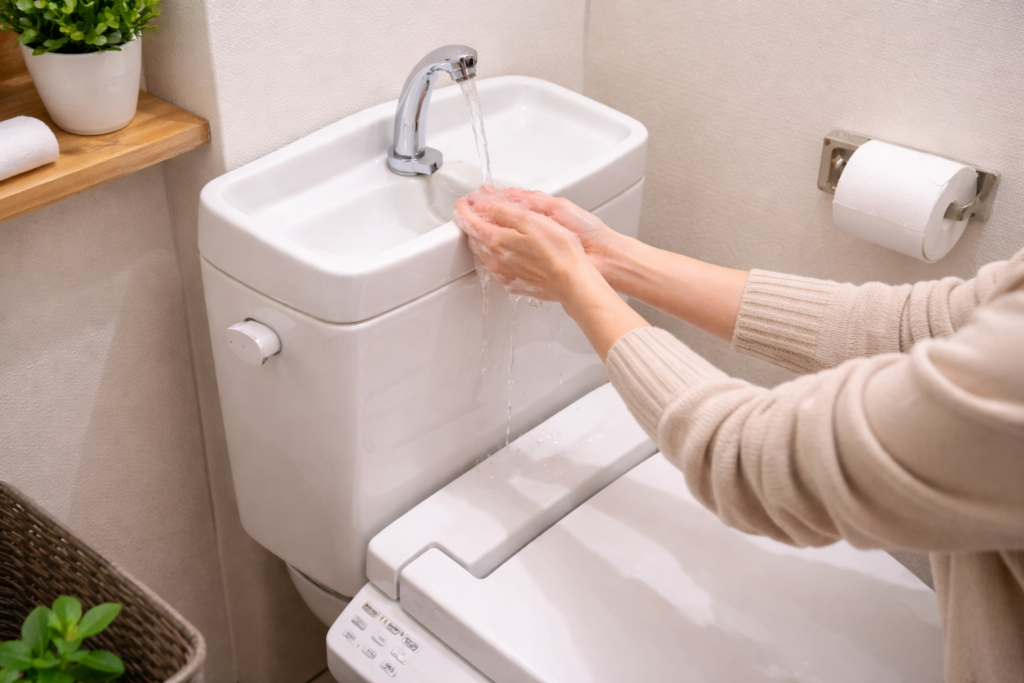
Why do Japanese toilets have sinks built right into the cistern? Because conservation is a design principle here, not an afterthought. The small faucet on top of the tank runs fresh tap supply for hand washing, then channels that greywater into the cistern for the next flush. One fixture, two functions, zero waste. This guide covers how the system works, where you’ll find it, and why the rest of the world hasn’t caught on.
What Is the Sink on Top of a Japanese Toilet?
A sink built into the top of a flush tank is called a tearai-tsuki (hand-wash-equipped) unit. When you press the flush button, clean supply flows from the municipal line through a small tap valve on the cistern lid. You wash your hands under that stream. The greywater drains directly into the tank below and waits there until the next cycle sends it into the bowl.
It’s a gravity-fed loop. No pump, no extra plumbing. Toto Ltd., the Kitakyushu-based company behind the Washlet, has produced these units since the 1960s.
Why Do Japanese Toilets Have Sinks on the Tank?
Conservation drives the design. Instead of sending hand-rinse runoff straight down a separate drain, the system captures it for reuse. A household that flushes five times a day saves roughly 8 to 12 liters daily. Over a year, that adds up to more than 3,000 liters per person.
Space matters too. Many Japanese homes, especially apartments in Tokyo and Osaka, have bathrooms smaller than 2 square meters. Fitting a standalone basin, a bidet-equipped unit, and storage into that footprint is difficult. Combining the hand-wash function with the cistern eliminates one fixture entirely.
Japanese culture also plays a role. Cleanliness standards in residential plumbing run high. Having a hand-washing station directly at the fixture removes the excuse of skipping hygiene after using the restroom.
How Does the Flush and Sink System Work?
Press the lever or button. The tank empties into the bowl through the valve, just like a western-style unit. As the cistern refills, supply from the line passes through the tap on the lid. You wash your hands under that stream. Soap residue and rinse runoff collect inside the tank.
When you flush again, the stored greywater does the work. No electricity, no batteries, no moving electronic parts. The refill takes about 30 to 45 seconds, plenty of time for a quick rinse.
Is Reusing Hand-Wash Greywater Hygienic?
Yes. The supply coming out of the tap is clean municipal quality, identical to kitchen faucet output. It only becomes greywater after you rinse your hands in it. That greywater sits in a sealed cistern until the next flush pushes it out through the sewer line.
There’s no contact between stored greywater and the drinking supply. Building codes require backflow preventers on all residential plumbing. After years of observing these units firsthand, I’ve never seen mold or hygiene issues when the cistern is maintained normally.
Types of Toilets You’ll Find Across the Country
Not every bathroom has a tank-top faucet. The country uses several distinct styles.
The traditional Japanese squat toilet sits level with the floor. Older buildings, some train stations, and rural homes still have them. These never include an integrated sink because there’s no raised cistern.
Western-style units dominate newer construction. Many models add a Washlet seat with a built-in bidet nozzle, warm spray, adjustable pressure, heated seats, and sometimes the sound of flushing played for privacy.
High-tech tankless models from Toto skip the cistern entirely. These wall-hung units use direct-supply flushing and pair with a separate wall basin for hand washing.
Public Toilets vs. Residential Bathrooms
Walk into a public restroom at a train station or department store and you probably won’t see a tank-top faucet. Public facilities separate hand-washing stations from individual stalls. Modern public units often use tankless systems, electronic bidet controls, and touchless sensors.
Residential bathrooms tell a different story. Many Japanese homes, especially older apartments and compact houses, rely on the tank-top sink because it saves both resources and space. If you’re learning how to use Asian-style facilities, the residential setup is the one most likely to surprise you.
Washlets, Bidets, and the Tank-Top Sink
People often confuse these three features. They’re separate systems that can coexist on the same unit.
A Washlet is a seat with an electronic bidet function. A nozzle extends from the rear and squirts a stream for cleaning. Most models include adjustable pressure, temperature control, a dryer, and a remote control.
The bidet cleans you. The tank-top faucet washes your hands. You can have a basic modern unit with just the hand-wash sink, a sophisticated Washlet without the faucet, or both together.
Why Haven’t Western Countries Adopted This Design?
Bathrooms in the United States and Europe typically have more square footage. A separate basin is standard. There’s less pressure to combine fixtures.
Building codes in some western countries complicate retrofitting. Greywater regulations vary by state and municipality. Cultural expectations play a role too. Western consumers associate separate, larger sinks with comfort. That perception is shifting as conservation research gains attention and compact designs spread to urban apartments worldwide.
Common Misconceptions Visitors Have
First-time travelers often assume the recycled greywater is unsanitary. It isn’t. The tap delivers the same clean supply as any other faucet in the building.
Another frequent mistake: thinking the faucet replaces a full vanity. In most Japanese homes, a separate basin exists in the changing area for face washing and teeth brushing. The cistern faucet handles the quick post-flush rinse only.
Some visitors press the button expecting the faucet to stop immediately. It won’t. The stream continues until the cistern finishes refilling. Just rinse your hands during the refill cycle and walk away.
Frequently Asked Questions
Why do Japanese bathrooms have two sinks?
Most separate the toilet room from the vanity area. The vanity handles grooming. The cistern-mounted faucet provides a quick hand rinse right after flushing. Two purposes, two zones.
Do Western toilets have built-in sinks like Japanese ones?
Rarely. A few aftermarket kits exist for western-style units, but they aren’t common. Most western bathrooms have enough floor space for a standalone basin, so the combined design hasn’t gained traction.
Are Japanese toilets hygienic?
Extremely. Between the Washlet bidet function, the sealed greywater loop, and strict building codes for residential plumbing, modern units meet or exceed hygiene standards found anywhere.
Why do Japanese toilets run when you sit down?
That’s the otohime (sound princess) feature. It plays a recorded flushing sound through a small speaker to mask noises. It doesn’t actually run liquid. Toto introduced it to reduce courtesy flushing, which wasted thousands of liters annually in public restrooms.